10
Actively collecting at roll-off
3
Mount architectures designed
CATIA V5Modular DesignCamera Mounts
Cable Management80/20 Extrusion3D Printing
Field DeploymentProduction Safety
🔒
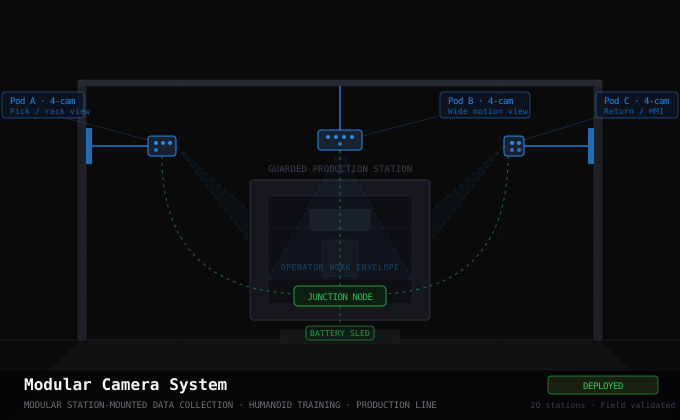
Station models, prototype photos, and layout drawings are proprietary and are not shown. The diagram above is an illustrative system architecture, not a reproduction of actual station geometry.
The Problem
Manual capture doesn't scale
Humanoid training data collection on the body line required a 3-person team per station: one operator performing the production task while two people held camera frames to capture hand motion and body movement. This worked for early pilots but couldn't scale across a full production line.
The operator workflow spans picking from racks, carrying parts, placing into fixtures, HMI confirmations, waiting through the cycle, and returning completed parts. Any mounting solution had to cover these views without creating trip hazards, blocking operators, or requiring stations to go offline for installation.
System Architecture
The deployed system groups 12 cameras into three 4-camera pods. Each pod has a local junction node for cable management, a support structure clamped to existing fixed station features, and adjustable boom arms for camera positioning. Three managed cable bundles route back to a central compute/battery sled.
Camera Pods
3 × 4-camera pods
Lockable adjustable mounts
Rigid boom arms
Clamp-on to fixed guarding
Mechanical Design
3 adjustable mount architectures
Tool-free compute/battery mounts
Swappable interfaces (80/20, I-beam, drilled)
Print-farm released 3D-printed parts
Deployment Constraints
Fixed guard / fence mounting only
No safety device contact
No floor obstructions
Operator clearance preserved
Illustrative system architecture · Guarded production station concept · Not actual station geometry
My Role & Deployment
Co-developed and deployed modular training-data hardware to 20 mounted production stations (10 actively collecting at roll-off), targeting a three-person-to-one-operator workflow. Co-led field surveys, assembly, wiring, commissioning, troubleshooting, and camera-angle iteration around live production.
- Owned CATIA V5 mechanical design for 3 adjustable camera-mount architectures and tool-free 3D-printed compute-module and battery-pack mounts
- Released designs to a print farm and standardized hardware for repeatable deployment and handoff
- Iterated camera angles with operators and data-collection leads based on field feedback from live stations
- Standardized mounting interfaces for 80/20 extrusion, I-beams, and drilled surfaces to adapt across station types
Lessons Learned
Field deployment is the real design review
Early prototypes on test conveyors validated the concept, but production stations exposed rigidity, cable routing, and operator clearance issues that only appear in context. Deploying to 20 stations forced standardization — every mount had to work the same way regardless of who installed it.
Design for the installer, not just the drawing
Tool-free mounts with locating pins and swappable interfaces mattered as much as camera coverage. If a station tech can't install or adjust the hardware in 30 minutes around a live line, the system won't scale — no matter how clean the CATIA model looks.
Cable management is a first-class constraint
Grouping 12 camera feeds into three managed bundles was driven by production-floor safety, not aesthetics. Ungrouped cables across a guarded station are a trip hazard and a maintenance headache. Solve the constraint that kills you in production first.