Summer research at WashU’s Computational Mechanics & AI Lab under Dr. Fanwei Kong, mentored by Yusuf Ozturk (Graduate). The project focused on replacing a legacy Fortran-based cardiovascular solver with a modern, ML-extensible Python pipeline — and coupling it with a 3D CFD solver to simulate realistic cardiac hemodynamics.
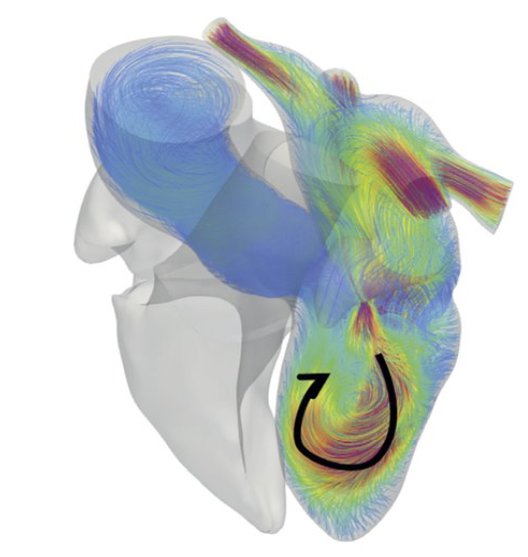
The video above shows the hemodynamic velocity field through the heart ventricle — the kind of simulation that traditionally takes hours per run. The goal was to make this fast enough for real-time parameter studies and eventual patient-specific modeling.
The core architecture couples a 3D fluid dynamics solver (full Navier-Stokes, finite element) with a 0D cardiovascular circulation model — a lumped-parameter electrical analog of the heart and vasculature. The two solvers exchange pressure and flow data at each timestep through direct function calls, no file I/O.
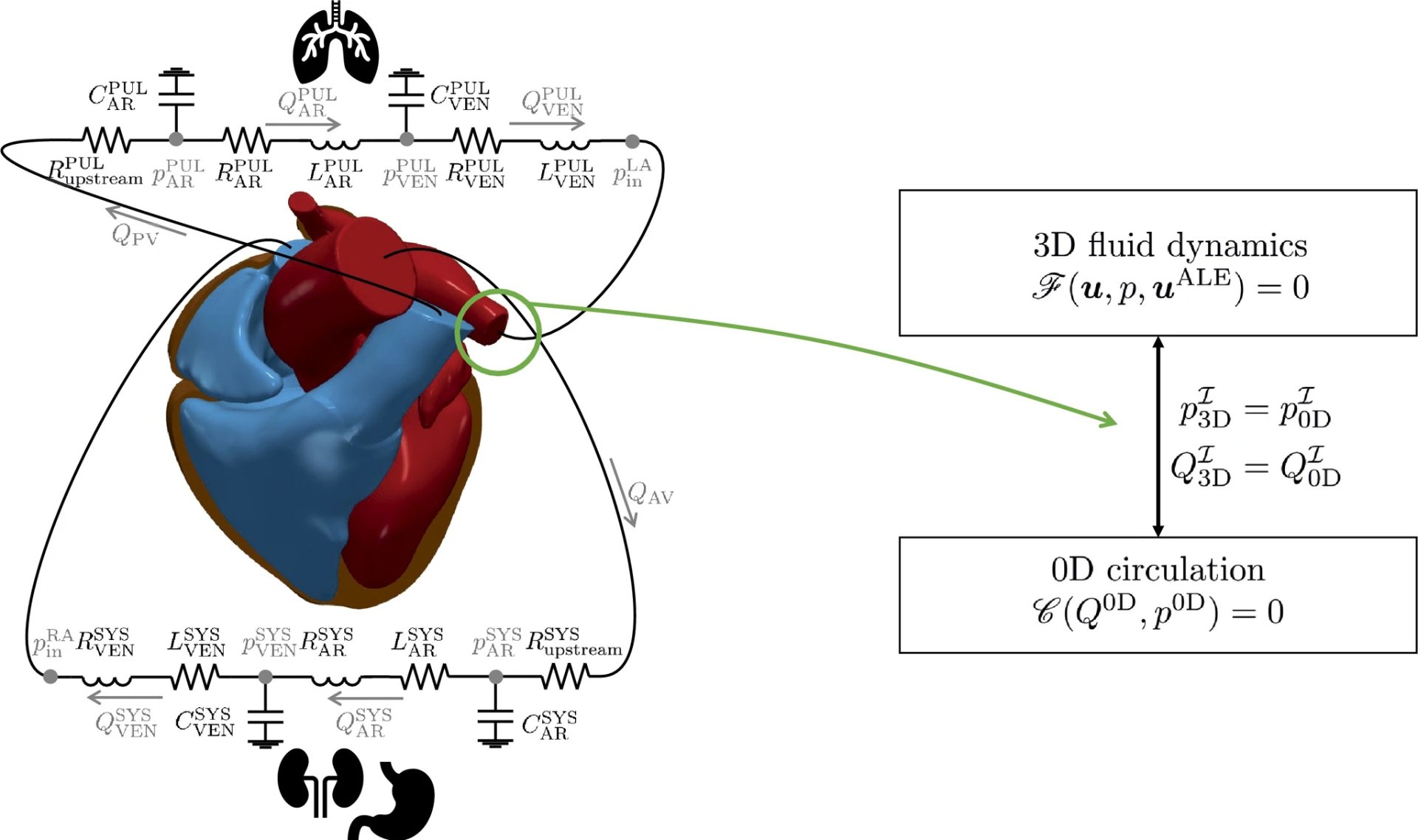
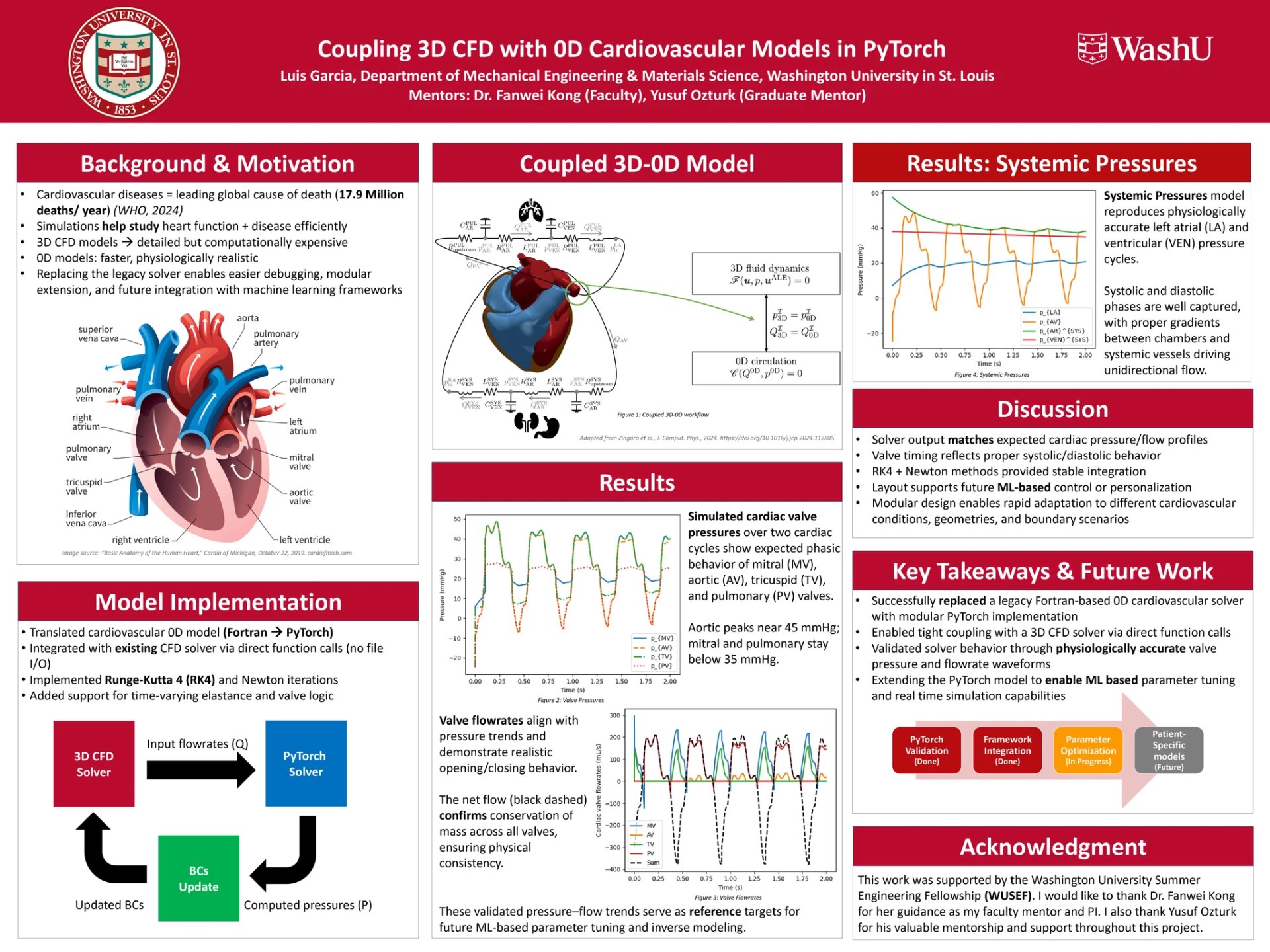
Findings were presented at the WashU Summer Engineering Fellowship (WUSEF) symposium. The poster covers the full pipeline: background motivation, coupled model architecture, implementation details, and validated results showing physiologically accurate valve pressure waveforms.
- Architected Physics-Informed Neural Networks (PINNs) in PyTorch encoding governing Navier-Stokes equations directly into the loss function — achieving 1000× reduction in simulation time vs. traditional 3D CFD solvers
- Built modular Python pipeline to translate legacy Fortran 0D cardiovascular solver — implementing RK4 integrators, Newton iterations, time-varying elastance and valve logic from scratch
- Coupled 0D circulation model with 3D CFD solver via direct function calls — enabling physiologically accurate left atrial and ventricular pressure cycle reproduction
- Validated cardiac valve pressure waveforms (MV, AV, TV, PV) — aortic peaks near 45 mmHg, mitral and pulmonary below 35 mmHg — against expected systolic/diastolic behavior
- Confirmed mass conservation across all valves; flowrates align with pressure trends showing realistic opening/closing behavior